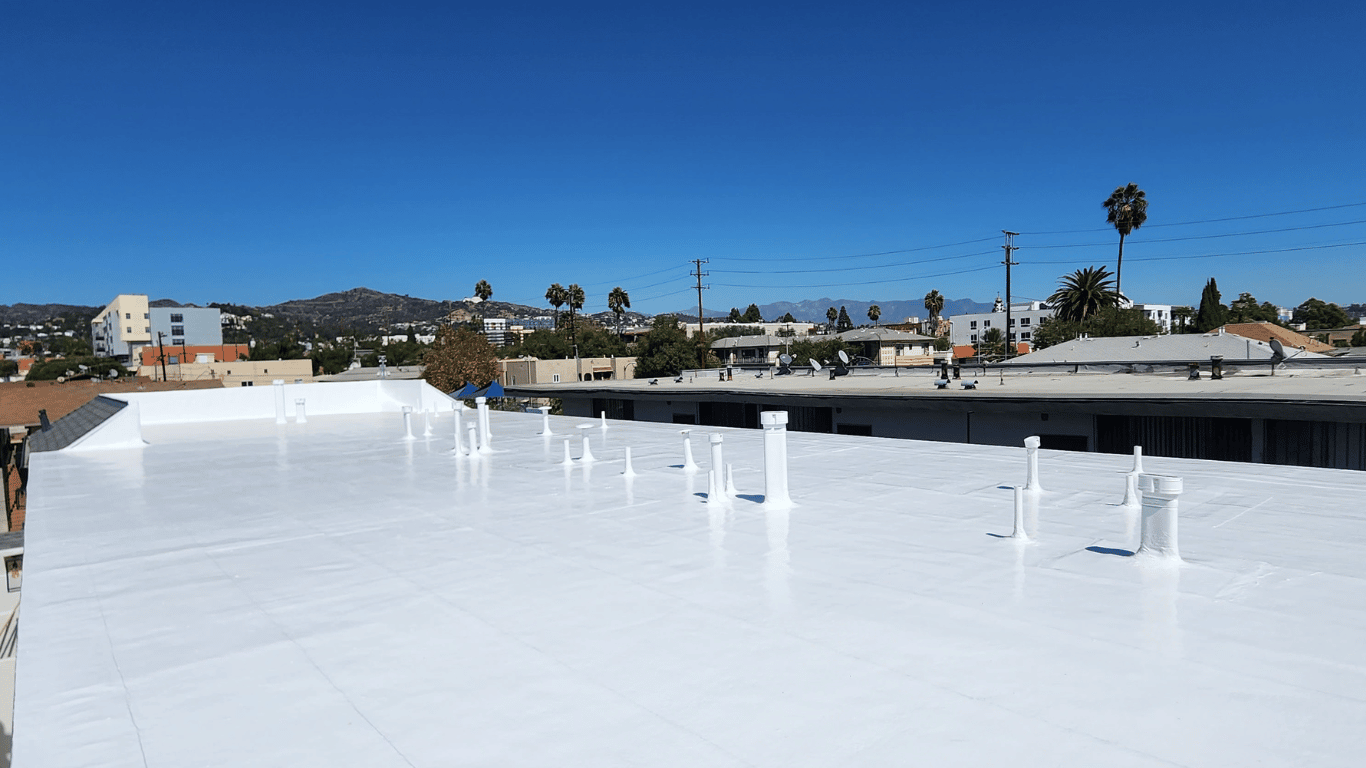
When a Newark-area property owner asks about energy efficient cool roofs, the real question is usually “is this the right call for this roof and this building right now?” Commercial Roofers of New Jersey answers that with a documented look at the membrane, the details, and the way the building gets used. This page lays out how we think about it and what an owner should expect.
There is no off-the-shelf version of energy efficient cool roofs. On a Newark-area commercial roof it has to fit the assembly that is already there — deck, insulation, membrane or coating, flashings, drainage — and the way the building runs day to day.
We start by reading the roof section by section: membrane age and seam condition, wet-insulation indicators, coping and edge metal, curb and penetration flashings, drains, scuppers, pitch pockets, prior repairs, and rooftop equipment traffic. On older Newark buildings the roof often carries decades of service changes, and energy efficient cool roofs has to account for the abandoned penetrations and patched curbs that came with them.
The honest answer is that it depends on the roof. Energy Efficient Cool Roofs makes sense when the assembly underneath is sound enough to justify it and when the building’s budget window and tenant situation line up. When it is not the right call, we say so and lay out the alternative — repair, recover, or full replacement — with the tradeoffs clear.
Around the Gateway Center and Broad Street corridor, parking, sidewalk protection, and crane or hoist positioning get decided before the roof scope is even priced. The logistics are part of the scope, not an afterthought.
The freeze line moves in and out all winter here. A detail can be wet and flexible one afternoon and frozen solid that night, and that constant cycling at parapets, scuppers, and field seams is harder on a roof than any single cold snap. We judge details by how they handle that movement.
Salt air off Newark Bay and the Arthur Kill is hard on metal. Fasteners, edge metal, gutters, and coping take corrosion faster here than they would inland, so we flag exposed and unprotected metal as part of the condition write-up.
None of that is a reason for alarm; it is just the reality a North Jersey commercial roof has to be built and maintained for, and it is why we judge a roof by how it handles repeated stress rather than how it looks on one dry day.
We do not start with a sales pitch; we start with the roof. The first step is a walk of the actual assembly and a conversation about the decision in front of you, whether that is energy efficient cool roofs or something the roof turns out to need instead. From there you get a documented recommendation you can act on.
Most of the buildings we work on around Newark and North Jersey stay occupied while the roof gets handled, so we plan the work around your operations — access, staging, interior protection, and the schedule — and keep you in the loop as it moves. The goal is a roof decision that holds up over time and a property that keeps running while it happens.
The first deliverable is a written read on the roof, not a number pulled from the air. We keep the scope tied to what the building actually needs and put the access notes, staging limits, and sequencing in writing so the roof work does not turn into an operations surprise mid-job.
That record is the difference between a plan and a guess. For energy efficient cool roofs on a Newark-area building it names the assembly we found, the details we inspected, the access and staging limits, and what we recommend — backed by photos — so an owner can take it to a board, a lender, or an insurer and decide with the facts in hand.