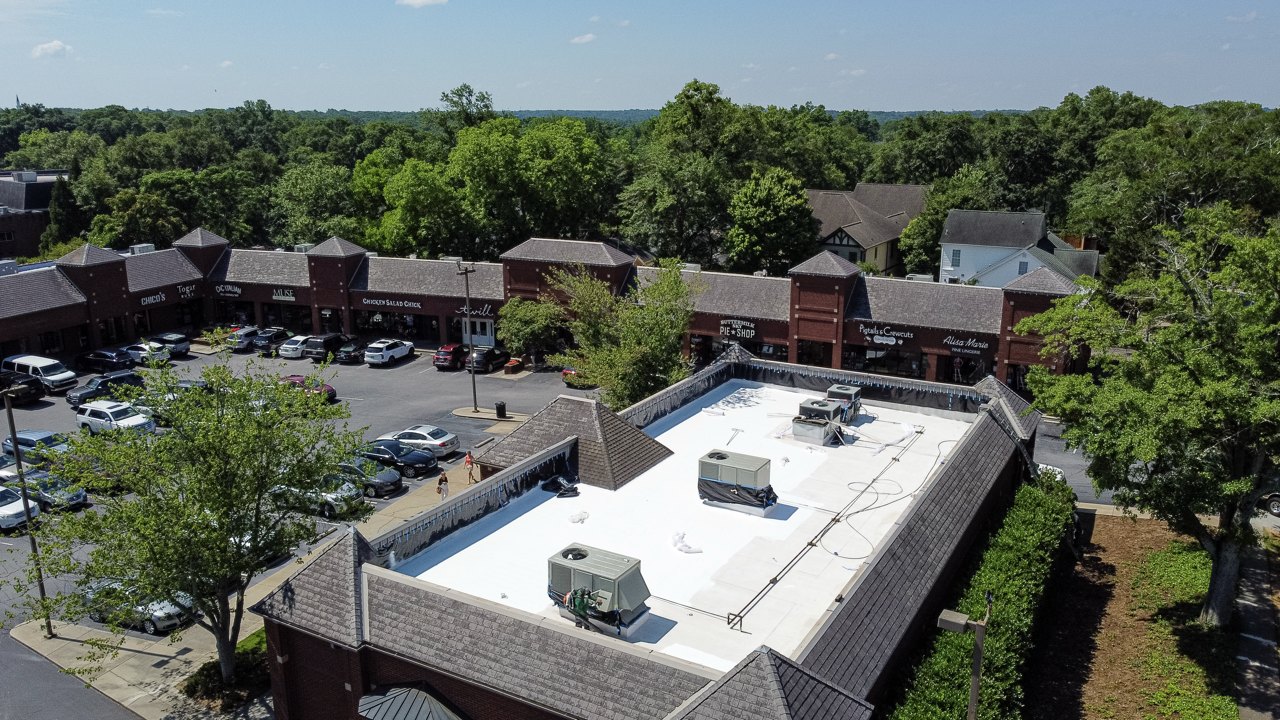
Commercial Roofers of New Jersey handles emergency roof dry-in on commercial roofs in Newark and throughout North Jersey. The first job is to find where water is actually getting in and to protect the interior, then to repair the cause rather than chase the stain. Below is how we scope it for a working Newark-area property.
Where the ceiling shows water and where the roof lets it in are usually two different places. So Emergency Roof Dry-In starts by tracing the path — seams, penetrations, curbs, drains, interior clues — back to the actual breach on a Newark-area roof, because fixing the wrong spot solves nothing.
Everything we find gets recorded — the failed detail, the condition around it, and how far water has moved inside the assembly. That evidence is what tells us whether a focused repair will hold or whether the honest answer is recover or replacement.
On an occupied Newark building, the first move is often a watertight temporary measure so the tenant can keep operating while the permanent repair is planned. Around the Gateway Center and Broad Street corridor, parking, sidewalk protection, and crane or hoist positioning get decided before the roof scope is even priced. The logistics are part of the scope, not an afterthought.
Once the interior is protected, we repair the cause with materials compatible with the existing roof system, so the patch does not become the next leak. We note warranty implications and whether the repair changes how the rest of the roof should be maintained.
Salt air off Newark Bay and the Arthur Kill is hard on metal. Fasteners, edge metal, gutters, and coping take corrosion faster here than they would inland, so we flag exposed and unprotected metal as part of the condition write-up.
The freeze line moves in and out all winter here. A detail can be wet and flexible one afternoon and frozen solid that night, and that constant cycling at parapets, scuppers, and field seams is harder on a roof than any single cold snap. We judge details by how they handle that movement.
Commercial roofs in this area fail through repeated stress, not a single event, so we plan the work around the whole cycle — heat, cold, wind, water, and salt — instead of just the worst storm on the calendar.
The work begins on the roof, not in a brochure. We walk the assembly, talk through the call in front of you — emergency roof dry-in or whatever the roof turns out to need — and turn it into a written recommendation you can actually use.
Because most Newark and North Jersey buildings we work on stay open during the job, we schedule and stage around how the property actually operates and keep you informed at each step. What you are left with is a roof decision that lasts and an operation that kept moving the whole time.
Before we price anything, we put the roof condition and the recommendation in writing. We keep the scope tied to what the building actually needs and put the access notes, staging limits, and sequencing in writing so the roof work does not turn into an operations surprise mid-job.
Written findings are what let an owner approve work with confidence. For emergency roof dry-in we document the assembly, the conditions, the access constraints, and the recommended option with photographs, so the decision can be defended to ownership, a lender, or an insurer without relying on anyone’s memory of a site visit.